

In key fields such as industrial production, data computing, and urban infrastructure, power security systems are the core cornerstone of maintaining business continuity and life safety. UPS (uninterruptible power supply) and EPS (emergency power supply) are two types of core backup power supply equipment, although they have the same power supply guarantee function, but their design concepts, technical paths and application scenarios are fundamentally different.
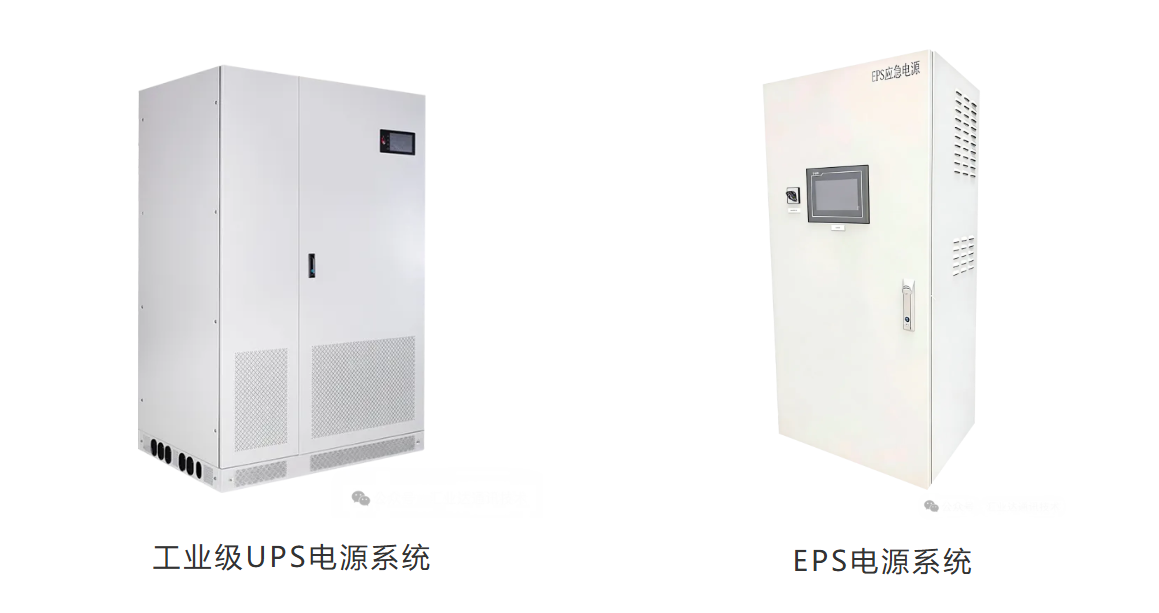
The core differences between UPS and EPS stem from the positioning differences in their design goals: UPS takes "equipment and data protection" as the core, and pursues "zero interruption" and "high purity" of power supply; EPS is guided by "life safety and security", focusing on "reliable switching" and "long-term battery life" in emergency scenarios. This positioning difference runs through the whole dimension of technical architecture, performance parameters and application logic, which can be clearly defined through the comparison of core technical parameters:
| Comparison Dimension | UPS (Uninterruptible Power Supply) | EPS (Emergency Power Supply) | Selection Core Guidelines |
|---|---|---|---|
| Core Positioning | Ensures continuous operation of precision equipment to prevent data loss and equipment damage. | Ensures operation of fire emergency equipment to buy time for personnel evacuation and rescue. | Check the protection object: Choose UPS for equipment/data; choose EPS for personal safety/fire protection. |
| Working Mode | Online mainstream double-conversion architecture (rectifier-inverter), full electrical isolation. Inverter operates continuously when mains power is normal, synchronously charging the battery. | Mains priority offline type. Under normal conditions, mains power is directly supplied and the battery is float-charged, with the inverter on standby; switches to inverter power supply during a fault. | Check power supply continuity: Choose UPS for seamless power supply; choose EPS if short switching time is allowed. |
| Switching Time | Online type: 0-10ms (seamless switching); backup type: 2-10ms, ensuring no perception by precision equipment. | 0.1-0.25s (100-250ms), meeting the requirements of loads such as emergency lighting and fire pumps. | Check load sensitivity: Choose UPS for servers/medical equipment; choose EPS for motors/lighting. |
| Output Characteristics | Sine wave output, THD<3%, voltage stability ±3%, compatible with capacitive loads, rated by apparent power (kVA). | Supports square wave/trapezoidal wave/sine wave, compatible with inductive, resistive, and rectified mixed loads, strong impact resistance, rated by active power (kW). | Check load type: Choose UPS for precision electronic loads; choose EPS for hybrid power loads. |
| Overload Capacity | Relatively weak, usually allows 125% rated load for short-time overload. | Extremely strong, can withstand 120% rated load for more than 10 minutes, adapts to 5-7 times rated current inrush for motor startup. | Check startup inrush: Choose EPS for motor loads; choose UPS for electronic loads. |
| Backup Time | Conventional 5-30 minutes, used for data backup and safe system shutdown, expandable via parallel or long-duration batteries. | Longer, conventional 30-90 minutes, extendable to several hours, supports linkage with generators to meet long-duration fire power supply requirements. | Check power supply duration: Choose UPS for short transition; choose EPS for long-duration emergency. |
| Safety Certification | No mandatory fire certification, follows general power safety standards. | Must pass mandatory CCCF fire certification, shell and wires use flame-retardant materials, supports fire system linkage, complies with GB 17945-2010 standard. | Check compliance requirements: EPS is mandatory for fire scenarios; UPS is optional for general scenarios. |
The core lies in "scenario adaptation", and the load characteristics, power supply requirements and compliance standards in different fields determine the selection direction of UPS and EPS. Based on the practice of massive projects, sort out the two core selection logics and solutions:
(1) UPS core application scenario: "power purifier" for precision load
In scenarios that rely on precision electronic equipment such as data computing, medical imaging, and communication transmission, UPS is the core of ensuring the continuous operation of the system and data security, and its core value is to provide "zero interruption, high purity" power output, filter grid fluctuations, harmonics and other interference, so it is called the "power purifier" of precision loads.
The specific selection points are as follows:
Data center scenarios: A high-frequency modular UPS is recommended, using a three-level IGBT topology and SiC hybrid design, with an efficiency of more than 96.5% (99% in ECO mode), and supports N+X redundant parallel expansion (a single system can be expanded up to 3.2MVA). It is optimized for high-density switching power supply loads such as servers and storage devices, with a peak factor of 3:1 and a dynamic response < 10ms. With an intelligent lithium iron phosphate battery system, it achieves 15-30 minutes of backup time (400kW load) to meet the needs of generator start-up transition. The integrated AI-driven BMS system integrates multi-dimensional analysis of voltage/internal resistance/temperature to warn of deteriorated cells 3-15 days in advance (accuracy >93%), and the battery system availability reaches 99.9999%.
Medical imaging scenario: The medical online UPS is selected, with an output voltage stability of ± of 0.5% (25-100% load step), a THD < of 1.5%, and a dynamic response of 0.5μs, eliminating the influence of power grid harmonics on imaging quality. It has passed IEC 60601-1-2:2023 Class B certification, with a leakage current < 100μA, and meets the EMC requirements of YY 0505-2012 medical electrical equipment. It supports hot-swap maintenance of key modules (inverters/static switches/controllers), with an MTTR < of 30 minutes and a system availability > of 99.999%.
Communication base station scenario: It adopts an industrial-grade wide-voltage input UPS (340-465Vac, ±15%), with built-in active PFC, and an input PF> of 0.99 to adapt to voltage fluctuations caused by long-distance transmission of rural grids. The efficiency of ECO mode is 98.5%, the dual conversion mode is 96%, and the annual power saving > is 3500kWh/base station. With -30°C~+60°C wide temperature range lithium iron phosphate battery (or special gel battery, -25°C~+55°C), the integrated intelligent temperature control system ensures that the battery compartment temperature is maintained at 25±5°C, the cycle life is increased by 40%, and 5 years are maintenance-free.
(2) EPS core application scenarios: the "lifeline" of emergency safety
In high-rise buildings, industrial plants, subways, commercial complexes and other places, EPS is the core power guarantee of the fire protection system, which needs to strictly follow the fire certification standards, focusing on long-term battery life, strong overload capacity and linkage control functions:
Metro emergency scenario: Customized EPS emergency power supply is recommended, adapted to core loads such as platform door power supply and smart lighting power supply, with 0.2s fast switching capability, supporting 120% rated load operation for 15 minutes, resisting motor starting impact. The backup time can reach 60-90 minutes, support linkage with the subway fire protection system, and automatically switch to emergency power supply mode in case of fire to ensure the normal operation of evacuation instructions and smoke exhaust systems.
Industrial plant scenarios: Recommend power-type EPS, for inductive loads such as fire pumps and fire shutter doors, configure frequency conversion start modules to reduce the impact of starting current; It adopts flame-retardant cabinet design, with a protection level of IP54, which is suitable for the dusty and high humidity environment of the factory. Reserve multiple independent output loops to distribute power according to fire zones to avoid system paralysis caused by a single point of failure.
Commercial complex scenarios: Recommended EPS for emergency lighting, supporting multi-loop output, and accurately matching the lighting load requirements of different areas; It has an intelligent dynamic guidance function, which can adjust the evacuation direction according to the fire alarm signal; The battery pack adopts a redundant design and has a backup time of ≥ 90 minutes, which meets the long-term power supply requirements of large building personnel evacuation.
For long-term practical use, the value of the power supply system lies not only in the equipment itself, but also in the stable operation and cost controllability of the whole life cycle. Huiye Da has been deeply involved in the field of DC power supply for many years, as a continuous cultivator of DC emergency power supply in the industry, has always focused on the research and development of DC power supply technology and the implementation of scenarios, focusing on core products such as DC emergency power supply and AC and DC power supply systems, in line with the practical application and upgrade needs of different scenarios, and creating a full-chain service system of "selection-delivery-operation and maintenance", so that the technical advantages of DC power supply can be transformed into the actual value of customers and maximize the benefits of the whole life cycle:
1. Precise selection support: Set up a professional technical team to provide on-site survey and load accounting services, and issue customized selection plans based on scenario needs to avoid the problem of "big horse-drawn carts" or insufficient capacity; For mixed load scenarios, it provides UPS+EPS collaborative power supply solutions to achieve dual guarantee of core equipment and emergency systems.
2. Standardized delivery system: Strictly follow the GB/T 14715-93 seismic standard and fire protection construction specifications to ensure that the equipment installation meets industry requirements; Provide equipment debugging and system joint commissioning services to verify key parameters such as switching time and overload capacity to ensure that the system passes the one-time acceptance.
3. Intelligent operation and maintenance management: All products integrate remote monitoring modules, support SNMP/Modbus multi-protocol access, engineers can check the operation status of equipment in real time through the web interface or mobile APP, and trigger double alarms by email and SMS when abnormal. Provide regular inspection and predictive maintenance services, analyze equipment operation trends based on big data, troubleshoot potential faults in advance, and shorten the mean time to repair (MTTR) to less than 30 minutes.
4. Cost optimization solution: Reduce initial investment through modular design, UPS supports on-demand expansion, avoiding redundant configurations; Promote lithium iron phosphate batteries to replace traditional lead-acid batteries, although the initial cost is slightly higher, but the life is extended to 8-10 years, the number of cycles exceeds 2,000 times, and the TCO is reduced by more than 37% in a 10-year cycle; Efficient products can enjoy national green energy-saving subsidies, further reducing procurement costs.
UPS and EPS are not a competitive relationship, but a complementary composition of the power security system - UPS guards the continuous operation of equipment and data, and EPS defends the bottom line of life and property. For engineering and technical personnel, accurately identifying the technical differences between the two and matching the needs of the scene is the core of design; For purchasing decision-makers, balancing compliance, reliability, and lifecycle costs is key. Based on the scenario demand orientation, the UPS/EPS product matrix covering the full power segment and the whole scenario and the whole chain professional service are the core support for realizing power security. Whether it is the precision power supply guarantee of the data center or the emergency safety protection of the subway and factory, the accurately matched customized solutions can help build a solid power security defense line and achieve safe and stable business operation.
Address: Building C, Haixinguang High-tech Industrial Park, at the intersection of Fengxin Road and Zhenmei Avenue, Guangming New District, Shenzhen City

Please fill in the form below and we will contact you as soon as possible after receiving your information. If you have any questions, please call us.